
Missionary Training
In 1987, we worked through the study course, "Perspectives on the World Christian Movement". God gave us a life vision to reach the remaining unreached people groups of the world. Like Paul, we hope to not build on another man's foundation but to go (and help others go) where Christ is yet unknown.
Through a series of guidance events, we decided to join Youth With A Mission (YWAM), the largest evangelical mission agency in the world. In early 1988 we completed a 5-month candidate-training program with YWAM at the U.S. Center for World Missions (USCWM) in Pasadena, California.
Oaxaca and its Indigenous Peoples (1989-2000)
Research by one of our fellow students turned up a state in southern Mexico, called Oaxaca, which was reportedly full of unreached Indian tribes. We were a bit incredulous, thinking that surely Mexico was fully evangelized. In 1989 we spent 3 months in Oaxaca to research the situation there, then reported our findings at our training center in Pasadena.
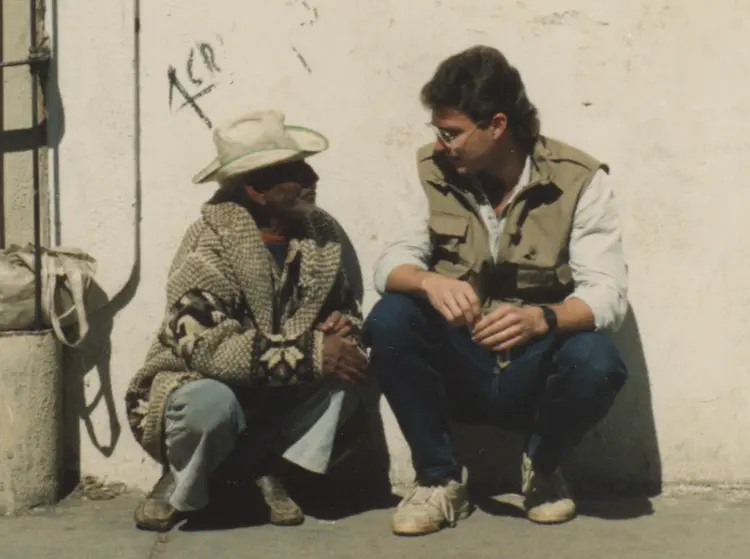
As we were evaluating our long-term options, a YWAM leader asked us to go to the Dominican Republic and help them through a crisis period. Towards the end of our 6-month stint there, in late 1989, a very historical event happened. The Berlin Wall was torn down, and with it, communism began to fall worldwide. We were excited! Perhaps it was time to move to the former Soviet Union for the harvest! While praying, we sensed that the Lord was rebuking us: “I sent you to Oaxaca to spy out the land, and you came back with a bad report (‘The ground was hard and dry; the people were unreceptive; the harvest is not ready!’). I want you to return to Oaxaca, and I will give you the eyes of Caleb and Joshua. If the walls of communism can come down overnight, Oaxaca is nothing for me!” We moved to Oaxaca in February 1990 to start a new YWAM center there.
Oaxaca is home to 174 different indigenous (native American) tribes. Our initial tasks were to learn Spanish, intercede for Oaxaca, and establish relationships with existing churches and mission agencies. Then we spent a great deal of effort, along with others who joined our team, to go out into the mountains village by village, systematically researching the status of Christianity in each tribe. We discovered that around 75 could still be categorized as unreached, and about 18 of those either had no known believers or had no organized Christian meeting.
From that research we prioritized the remaining missionary task in Oaxaca. We created informative profiles on dozens of needy tribes. We wrote and published a 30-day prayer guide on the unreached peoples and produced a video to make others aware of the needs in this area. We called for new workers to join in the harvest. We sent out our findings to 400 Latin seminaries and mission agencies and invited them to send church planters. We hosted pastors’ seminars and partnership meetings between mission agencies, spoke at numerous conferences and churches, and did everything we could think of to call forth laborers and direct them to this harvest field.
Thirty-one tribes have now been adopted by a Christian entity that has pledged to begin new churches among them. YWAM has trained and sent church planting teams into 5 different tribes. A number of tribes have been reached over the last twenty years.
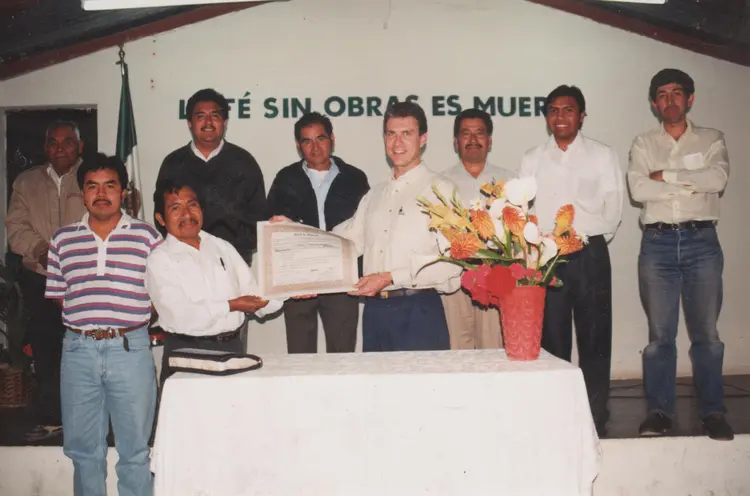
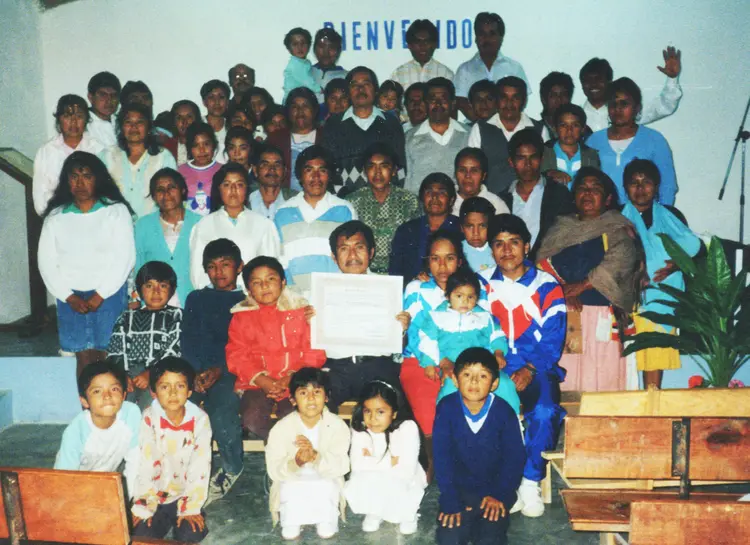
A church in Nochixtlán, Oaxaca, adopts an unreached people group
A New Missions Force
At the same time that we were founding a YWAM center to focus on Oaxaca's unreached tribes, our personal vision was broadened by a couple of key events - a Oaxaca statewide missions conference in October of 1991, and the first national-level missions conference in Mexico in the Spring of 1992. At both of these conferences, significant numbers responded to challenges from the platform to get involved in world missions. Yet we knew that there was little infrastructure within Mexico to train, send, and support missionaries. We began to feel a burden to get involved with mobilizing Mexican missionaries. Our paradigm shifted from viewing Mexico only as a mission field to seeing it also as a mission force.
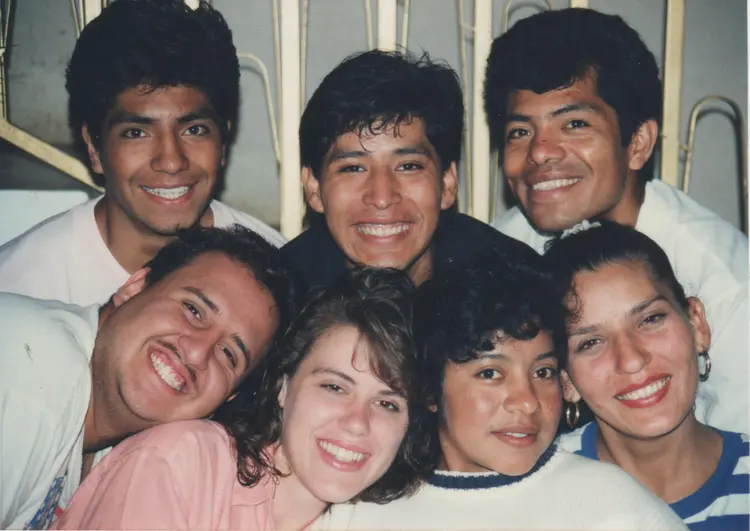
Our first group of missionary trainees
While we were laying the groundwork for training programs in Oaxaca, others were sensing a call to come to Mexico and help mobilize this new missionary force. By 1994, there were ten YWAM centers scattered across Mexico, with roughly 120 total staff and a variety of ministry visions and focuses (a big jump from two centers and 30 staff at the end of the 80s). Mark was asked to coordinate these works nationally and in 1995 became YWAM’s first National Director of Mexico. He stayed in this position until May 2000, when he turned it over to a Mexican counterpart.
While co-leading the Oaxaca YWAM base, Gina began to broaden her scope of responsibility by taking on the role of Regional Frontier Missions Director for the Caribbean, Central America, and Mexico. She challenged all 30 YWAM centers in this region to focus attention on reaching unreached people groups nearby and around the world. Nearly every base adopted a specific unreached people group. Many exciting things have happened – Barbados sending 12 missionaries to a Muslim tribe in West Africa; Belizeans going to Senegal; Panamanians in Mauritania; Puerto Ricans in China; even Haitians going to their ancient homeland in Benin to reach their distant Muslim relatives.
Spain and North Africa Fill Mark’s Plate (2000-2010)
In Latin America, there is great interest in missions to Muslims, particularly in the Arabic world. This can be attributed to deep historical and spiritual roots. In the late 700s, Arabic-speaking Moorish warriors from North Africa swept northward into Spain, conquered the region, and stayed for the next seven hundred years. The year that the last of the Moorish invaders was driven out of Spain was 1492 - the very same year that Christopher Columbus departed for the New World under the Spanish flag, taking with him seven hundred years of Arabic Muslim influence on Spanish culture and language. Christians in Latin America seem to feel an acute burden to take the gospel to North Africa, as if to set the record straight.
At the end of 1997, we began to sense that our work in Oaxaca and Mexico was drawing to a close. In May 1998, we turned the Oaxaca YWAM leadership over to Esaú and Alejandra Pérez, a fine Mexican couple. After a period of praying and checking out options, Mark felt in December of 1999 that our new home would be southern Spain, where YWAM’s North Africa Center (NAC) is located, as he accepted an invitation to become the Center’s director.
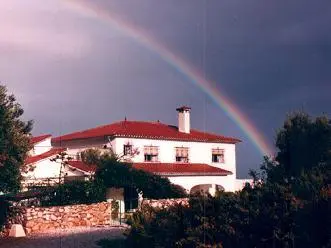
YWAM's North Africa Center in southern Spain
The NAC is a multi-faceted ministry center that exists entirely to support YWAM’s efforts in the nine countries that make up North Africa. The over-arching goal is to see strong indigenous churches begun in the 18 major people groups of the region. Specific tasks at the NAC range from identifying staff needs in the field to recruiting, training, and placing workers to providing logistical support for the field workers in a wide range of areas such as processing financial support, developing small businesses and projects, conducting research, providing pastoral care for teams and individuals, and church-planting coaching. The NAC houses the finest mission research library on North Africa and is an active hospitality center, providing a place of rest and refreshment for YWAM’s field workers and a way station and orientation point for workers going into and coming out of the region.
YWAM is a charter member of the North Africa Partnership, one of the most successful multi-agency missions initiatives to date.
A Global Vision, A Global Challenge for Gina (2000-2012)
Since 1995, Gina has served on the International FM Leadership Team that oversees YWAM’s entire mission endeavors among unreached peoples. With the move to Spain, she transitioned from her role as Frontier Missions Regional Director for Central America to a more worldwide platform of influence and impact. For four years, she concurrently held the positions of International Director of Mobilization for YWAM Frontier Missions and Global Adopt-A-People Coordinator for YWAM.
In 2004, Gina was chosen by her peers on the International FM Leadership Team to fill the highest position in our branch of the organization, International Director (IFMD). This also made her a Vice President of YWAM and a member of the executive committee of the Global Leadership Team (our equivalent of an international board of directors). She served in those positions for eight years, directly holding 100 international leaders accountable for their efforts and bearing the ultimate responsibility for over 2000 FM workers around the world.
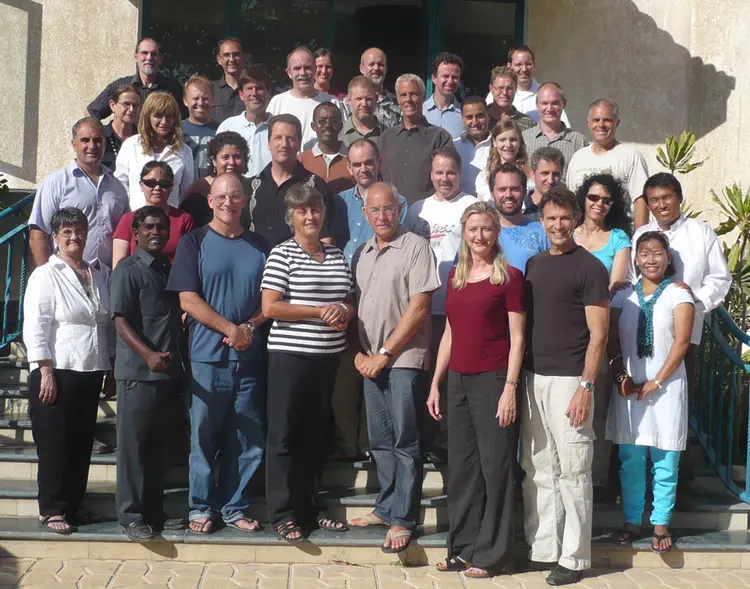
Gina and YWAM's Int'l. FM Leadership Team
Gina continues to be actively involved in a partnership called "Table71", a cooperative effort among the Southern Baptist IMB, Cru, YWAM, Wycliffe Bible Translators, Transworld Radio, and others, working together to reach 630 people groups where no Christian missionary effort exists.
Earlier Times
Mark grew up in Liberia, West Africa, where his parents and grandparents served as missionaries with the United Methodist Mission Board. His mother died in Liberia just before he finished high school there. He graduated as valedictorian of his class, then his family returned to the USA. Mark's father married another missionary and the family moved to Cocoa, Florida, to care for Dr. William Hughlett, her widowed father (who also had been a missionary in Africa for 42 years). Mark committed his life to the Lord when he was 22 years old and two years later felt called into missions. While finishing up his university studies, he was introduced to Gina by Dr. Hughlett and soon married her. In 1985, Mark graduated Summa Cum Laude from the University of Central Florida (UCF) with a degree in Mechanical Engineering and then worked for Martin Marietta Aerospace for two years.
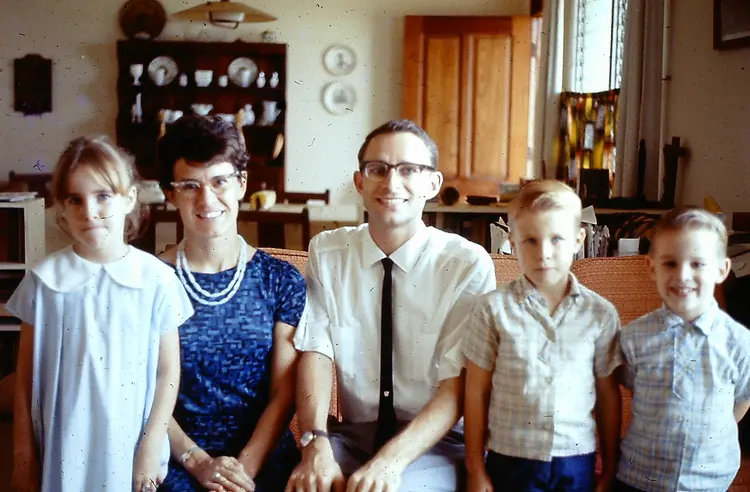
Robin, Karis, Tony, Mark, and Jonathan Fadely in Liberia, c. 1967

Gina Cowart grew up in Cocoa, Florida, where six generations of her family have now lived. Her great great grandparents were one of the six founding families of First Baptist Church in Cocoa. At age 8, she became a Christian and joined First Baptist Merritt Island, where she remained very active until she moved away to college. In three years time, Gina graduated Cum Laude with a degree in Business Finance from the University of Central Florida. After college she worked for IBM in Orlando. During this time she went on several mission trips to Haiti and knew that her life would be involved in world evangelization. Because of that interest, she spent a considerable amount of time with her neighbor, Dr. Hughlett, who eventually introduced her to his visiting step-grandson, Mark. A common mission vision was instrumental in our quick romance and marriage in 1985.
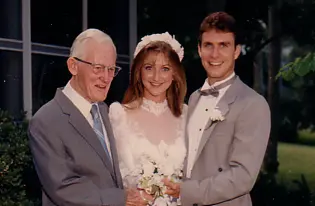
Dr. William Hughlett at our wedding in 1985
